Want to build career in international development? Don’t reach for the UN

I have started doing university lectures and helping students who want to work in “international development.” One of the questions I get the most is: How do I get an internship at the United Nations (UN)? And this is understandable: The UN, and other intergovernmental organizations (IGOs) like it have worldwide recognition and affect how we see international development. For some, just interning at an IGO is seen as a ticket to a great career.

However, I don’t think it’s a good idea to build your career at these kinds of organizations. Why? If you are just starting, you need to spend a lot of time learning: about yourself, your field, your skills, and your contributions. Figuring these things out takes a huge amount of self-awareness, mentoring, and mistakes. Lots of mistakes.

Why you shouldn’t intern at the UN

You need to try things you are not particularly good at and challenge yourself. And I believe that an IGO is not a great place to do so. Here’s why:

a) As an intern, while the work you do will be helpful to the organization, given its size, you might not get the attention you need. It will be hard to get proper training, mentoring and guidance.

b) Unless you are in a cross-functional area, like knowledge management, or monitoring and evaluations, your area will have its own work plan and budget and will function very much independently. As a result, you will have a very limited perspective of the work of that organization.

c) Most interns who are even qualified for those positions already speak multiple languages, have a graduate degree, and some work experience.

d) The chances of converting that opportunity into an actual paid position are slim: it’s hard to stand out and there is lots of competition to simply be interns.

e) Internships don’t always include fieldwork. I know it sounds obvious, but many people go into those internships thinking they will have access to some on-the-ground work. It is more focused on bureaucratic and diplomatic functions.

f) Most of all, it takes a certain amount of self-assurance to be able to determine, on your own, what assignments do you think you can contribute to your overall career expertise. It’s hard to take ownership of your work if all you can do is accept tasks that are given to you.

I’m not against IGOs; I work with them often and I think they do great work. However, this is not about them. It’s about what’s best for you.

Instead: act local, think global

If you are just starting, there are plenty of other ways to get sound experience in development that will actually result on you having transferable skills. Here are a couple first steps:

First, I would advise interning at a local organization or project. Remember the motto: act local, think global. You don’t need to leave your country to get development experience. If you don’t know where to start I would take a look at nonprofits in your community. If you’re in college, look on your campus. You can also research on Idealist for any opportunities in your area. If you find something that really strikes you, you can always write the organization, asking for more information on their internship policies.

If you want to intern in a different country, you should look for the national offices of the NGOs you want to work with. Local chapters and national offices might not have as many interns working for them, but will have a lot more need for helping hands and qualified work. Moreover, interning in a different country will give you a great opportunity to learn the dynamics of local implementation.

Finally, there is always the alternative to pursue paid and unpaid fellowships that will help you develop transferable skills and get some international experience.

Nonprofits and international organizations alike don’t want to invest a lot of money on someone that they later found out can’t handle trash, pollution, crowds, isolation, violence or simply just being away for their country. So, fellowships are a way to establish that you can handle different context and as well as being able to adapt to it. Also, YOU need to see for yourself if you have what it takes. International work is highly romanticized and it can be a truly wonderful experience, but it can be tough and those conditions are not for everyone. They don’t have to be.

In case you are just beginning to look, I would recommend to take a look at Standford’s page of Fellowships, Internships and Service Programs (FISP) Database, NGS Opportunity Database or VSO International. Those are general databases for fellowships, but they will allow you to have a big picture of what is being offered. You can also start focusing on what motivates you and the skills you want to develop. Remember, people in our field respond to motivation, determination, flexibility and willingness to learn. Embrace that.

Best of luck in your search!

This article was first posted at Idealist.

Newsletter #1 - Welcome to the club!

Geneva

If you are getting this newsletter, you sign up for jobs in International Development (if not, I hate to break to you, someone did…), welcome! This first message is an introduction to myself, to this project and what will be happening in the coming weeks. Don’t worry, you can sign off anytime if you feel like this is not really for you… Or if you land a job you love!

First things first. This is not a job board. I repeat, THIS IS NOT A JOB BOARD. There are many of those out there and my point with this is not to advertise positions, but help you through the process of discovery your strengths and the job that suits you the best. If that interests you, great! You are in the right place. Let’s start?

A little introduction is in order, don’t you think? My name is Natasha Leite and I’m from Brazil. I am not a HR manager in any shape of form. My background is Law and International Relations, I have a MA in Conflict, Security and Development and I have worked for many organisations during the last 9 years on issues of Governance and Citizen Security in Latin America, the Caribbean, Africa and Asia.

So… How do you think I can help, you ask? That’s a pretty good question. I’ll let you on a little secret. I have never been unemployed for over a month. Never. Yet, I have plenty of my IR/CSD friends struggling to find a job. A lot of people going for PhDs and civil service because it seems like the “safest” bet. Am I smarter or more qualified than they are? As much as I would like to think so, that it’s simply not true. It’s almost an endemic problem within how our programmes are structured; our personal profiles and how are choices are presented to us. That sounded a little cryptic? Good. I want to keep you hooked for the next weeks. ;)

Basically, I am using my own job-hunting background, my friends’ failures and successes and my experience as a panellist in UN recruitment processes to help you understand what will be the best way to get into a career path you are excited about. This will not be a passive process, though. I will engage in some serious questioning of your purpose and your interest on this field. This will never be to undermine your confidence or belittle your reasons for wanting to work in international development, however you do have to be ready to justify your motivations to a future employer or even to yourself when a rejection letter arrives. Most students are only asked that when they are starting their majors and after that they end up focussing on getting through a class, finishing a paper and getting to the UN or on that said rejection letter. If that was you… Or still is… I can already tell you, part of the issue is you are focusing on the wrong things. Don’t worry, that’s easily fixed.

The Habits of the World's Smartest people

As usual, I’m working on several projects at once, but I’m also working a lot with people on how to reach their goals. I saw this infographic and I though it was really interesting… Not that you have to be a night owl or use drugs to perform better, but that even for the smartest minds, it takes work and dedication to create successes.

What is “the project”?

cropped-84224865.jpg

For most people that come to my page lately have become intrigued with the ebook tab that suddenly appeared. What’s going on?

I am now discussing with my two Universities (yes, again the UK-Brazil connection) how to support International Relations/International Development students to find “jobs”. Moreover, to discuss with students the realities of international development and what it means to have a life plan. No… This is will not be new age self-help book or a book with lists and lists of aid job boards. This is more of a creating a sound strategy for action and following through with some inside tips on how to boost your profile, reach the most effective channels and not wasting time and energy on things that you are not interested about.

I have devised a little Q&A to help me get through the main questions:

Why are you doing this? Are you still employed?

Yes, I am still working with UN agencies, with the Kashmir campaign for Beyond violence and writing a lot of articles. I’m doing this ebook as a way of compile years of advice to fellow IR students in one place (saving myself some time) and helping universities be more effective in their response to students. There are two answers for my approach to this. One is actually part of my advice on this process: find what you love doing and do it! I love helping people unleash their true potential. That is as true for women in Brazil to youth in the Maldives. Most people already have the knowledge of what they love doing and what they want to be. They just need a method or a help getting started. The other answer to this is that Development is the business that I know and I was able to succeed in, but in that process I had some pretty amazing mentors who helped me through it. So… It was time to pay it forward.

Are you getting money out of this?

Yes and no. I’m not making money out of this website, newsletter and podcasts. None of those will be charged. I will charge for the ebook because I want to release a quality product, so it will need proofreading, a professional cover and decent publishing[1]. That being said, I intend to be in the 2.99-5.99 frame, so, at most, you will give up a coffee or two (half, if you are into the fancy stuff) and I will have regained my “initial investment”. If after all of those, you still feel like you need one on one consulting, then those services will be higher priced.

Explain that consulting bit…

This has many reasons: most and foremost, I don’t have that much time. The idea of the page, newsletters, podcasts, Q&A sessions and ebooks is that you will have as much content as possible without having to get to me directly. I work full time in development and I really enjoy my work, so, if I am investing my time on someone, I want to make sure that they are invested in the process too. That’s also why I would only consult in packages of three meetings. I want to get to know you, your strengths, give you things to work on, help you measure progress and give you the opportunity of have your money back if this is not a system you are comfortable with. I want to make sure that I can help you in the first place, plus that my success rate will not be going down =P.

Are you coming to my University?

I’m talking to PUC-Rio and University of Sussex right now, because those were my Universities. We are having some fun ideas for podcasts and Google Hangouts, so there will be a chance of asking questions at some point, don’t worry.


[1] I am aware that there are ways of doing it for free or cheaper than the traditional route, but it would mean that I would have to spend time I don’t really have on things that I don’t really know how to do it. The trade off just don’t seem worth it.

Protests and violent repression in Ukraine and Brazil

Protest Brazil

In light of recent events in Ukraine and in my home country, Brazil, I decided to focus this particular post on how non-violent resistance is taking form in recent democracies and how activists are “fighting back” civil and political rights violations.

If you are unaware of the latest protests in Ukraine, I strongly suggest you visit Beyond Violence’s campaign profile (1).Protestors are being met with extreme violence, unlawful incarceration and having their right of privacy violated. Personal information, private messages are being used by the government as evidence of “treason” in a less-than-democratic attempt to remain in power and dissuade protestors.

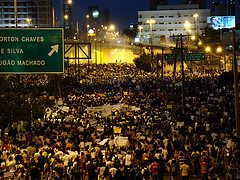
Meanwhile, in Brazil protests started in June last year on what was called “June Conferences” (Jornadas de Junho). They started with no party ownership against government corruption directly tied to the organisation of the 2014 FIFA World Cup, the increased cost of living, and rising transportation costs but were harshly repressed by law enforcement forces. By February 14, 20 protestors have died and several thousand were injured (2). Furthermore, a new bill is being discussed (3) in Parliament which could justify charging protestors with the crime of terrorism. The bill itself hasn’t sparked any specific organised reaction from the protestors, but it does fit into a larger framework of government oppression and civil rights limitations.

Analysts have been calling these protests a “Tropical spring”,which is a disservice to those countries that held the “Orange Revolution”and the movement of “Caras Pintadas“(4). Protesting, at least in Brazil, has become the very essence of active citizenship. Since voting is mandatory, protesting is the “active” way of expressing your citizenship and political opinions.

From a legal perspective, the demonstrations in Brazil and Ukraine show clearly the inability of the governments to guarantee and uphold the Covenant of Civil and Political Rights (1966) and the Human Rights Declaration (1948). Those, alongside the Covenant for Social and Economic Rights, are the foundations of the Human Rights framework. So, it’s up to the international society to keep an watchful eye on what is going on to make sure those principles we fought so hard to maintain are implemented to the highest standard.

The internet has been established as an important tool for civil society organisations, activists and movements to inform their peers and outside parties about human rights violations, injustices and corruption. It has become a powerful instrument for advocacy and political pressure in order to hold governments, powerful individuals and corporations accountable for their actions or at the very least those international networks of activism could put in place protection mechanisms for Human Rights defenders and reporters that are being targeted for exposing the truth around the world.

In Brazil and Ukraine, social media is the primary means of communication for protestors to arrange meetings, report incidents and mobilise support. However, it is actively monitored by government officials who are not only threatening the right of privacy, but also the right of free association, freedom of assembly, freedom of information, freedom of press and - you guessed it - freedom to protest. Let me repeat that governments are using private and personal messages, without legal grounds, to threaten activists, their associates and acquaintances. Non-violent protestors are being compared to terrorists and democratically elected governments are using brutal force and intimidation to subjugate their own citizens.

Fortunately, these tactics won’t stop people getting their messages out. The group Frontline defenders, for instance, has launched a series of manuals for activists on how to protect your online privacy. Frontline SMS and Voxer are also great apps for communication, storing messages online and allowing communication even without Internet - walkie-talkie style.

But most importantly, we, civil society, have to stay alert and hold those governments accountable online, at international fora, in Human Rights Courts and more. Making sure that when we said “Never Again!” to civil and political rights violations, we actually meant it.

Notes:

  1. The protests are a consequence of President Yanukovych’s rejection of an accord with the European Union in November 2013 in favour of stronger ties with Russia. This came as a surprise to thousands of people. Outraged with the government’s objection to further the country’s own economic and social development, they took to the streets of Kiev to peacefully object to this decision and the corruption involved. They occupied Independence Square, known as Maidan, until the 21st of February, when an EU-mediate peace agreement was signed between opposition and government.

  2. These are very conservative numbers, however, there is no consolidated data on the deaths during protests. It is a nation-wide movement, with several different sources of data, which in a lot of cases don’t match. Furthermore, a lot of the deaths during protests have been categorised as an accident or unidentified death, which makes the gathering of data even more difficult. There have been some media efforts to keep track of those incidents, but those can be considered somewhat biased as well.

  3. The Bill PLS 278/2011 was introduced in 2011 with thoughts of having it approved before the World Cup (2014) and it was being discussed in different chambers within the senate in 2013.

  4. Caras pintadas (painted faces) was the student movement (1992) in Brazil that spearheaded the impeachment of the first democratically elected president after the military dictatorship, who was accused of corruption and embezzlement.

Natasha Leite has worked for the last 9 years with Governance and Security in Latin America, the Caribbean, Africa and Asia. Currently she is working with Youth Development at UNICEF Maldives.

This image was originally posted to Flickr at http://flickr.com/photos/31746947@N05/9098683146

Post originally at Beyond Violence.

Let’s Lean In on the “Lean In” wave

132075102“Lean In” has become one of the most important pieces of writing of the last 5 years of the challenges for women in the workforce in intermediate to mid-level positions. It has reached a mainstream audience and for feminists and feminist networks it has now become a staple book for discussion. More than just agreeing with it wholeheartedly or simply refusing to read it, it is important to understand what its faults are, but also how to galvanize its momentum for a broader gender equality agenda.

First, let me just say, I don’t think the book’s message is universal. I think it addresses structural challenges for (mostly white) women to succeed in Corporate America. Following its neoliberal tendencies, it puts a lot more emphasis on the individual women, than it does on the structural challenges that prevent their ascension to leadership roles.

I still think the book it’s important though. Not because it’s message it’s new or inclusive, but because it is opening a discussion about the difficulties of women within several patriarchal structures that most mainstream channels didn’t even begin to question. The author of the book, Sheryl Sandberg, is admittedly not a Gender studies scholar or an activist. I think it would be disingenuous of her to do so. It is a lot about us now, to take this space and move the discussions forward.

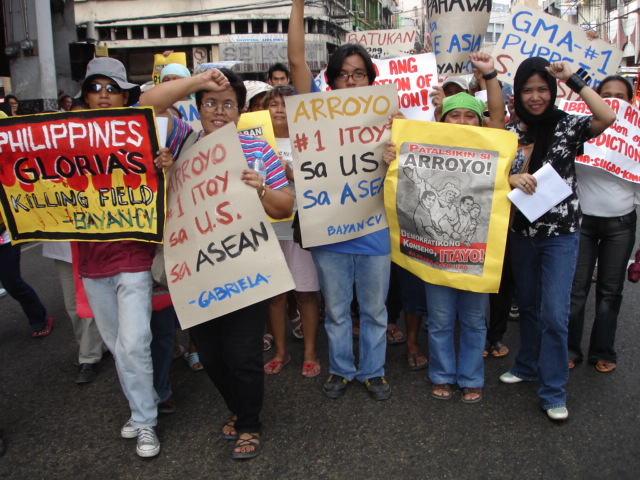
[caption id=“” align=“aligncenter” width=“640”] Women’s demonstration in the Phillipines, rights reserved to Kilusang Mayo Uno.[/caption]
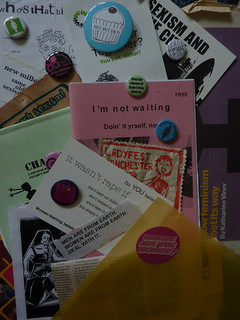
Third wave of feminism is about inclusion, so let’s bring our issues to the table. We want to talk about inclusion in the workplace, women’s representation in media and women’s representation in government. Let’s talk about violence against women, harassment on the workplace/in the streets and sexual violence. Let’s use this opportunity to have open discussions on the need of comprehensive sex education, abortion, especially in conflict-zones and access to birth control and family planning. Let’s use this space, more than ever, to allow us, women from Latin America, Asia, Africa, indigenous women, black women, queer women to have a more significant voice in feminism, politics and on the development agenda. Let’s discuss identity, our heteronormative culture and fight discrimination, misogyny, homophobia and transphobia.

My point is, I believe we have to be intersectional and inclusive, but also smart and getting our messages across and transforming power relations. Sandberg’s neoliberal feminism is not perfect, like TED Women is not perfect, or UN Security Council resolution 1325 is not perfect but they are getting women’s rights in the mainstream agenda. We need those spaces, we need to change those structures. Rather than op-out of the dialogue we can use this moment and those openings - not to undermine those struggles, that are in themselves valid - but make those spaces more meaningful for all of us and to get closer to actual gender equality.

The importance of "Yes"!

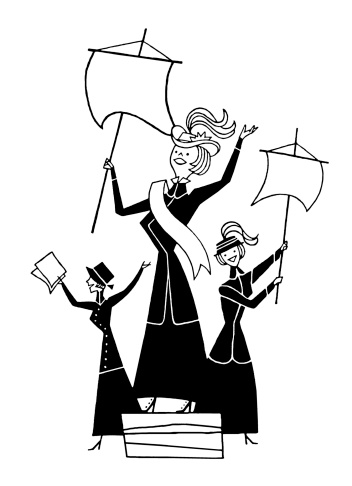
3716872426_b57f31893c_nSo, for those of you who are following Women’s issues discussions on twitter yesterday was the Tweetathon (is that even a word? Well, you get what I’m saying…) #RingtheBell and #NomeansNo. Reinforcing that we live in a society that not only condones rape, but in many contexts, actively promotes it and we should not stand for it. And what I want to start discussing, at least on this post, even if it is to myself, is how to flip this to empower women about their sexual choices in order to create more healthy and equal relationships with sex and ourselves. In an ideal scenario, fostering sex-positive views would allow women and men to be more open to their needs as well as not feel the need to rush into something they are not ready to.

First things first, people have the right to stop unwanted sexual advances and under NO circumstance it’s the victims fault when they are sexually assaulted. (1) I mean… If you don’t agree with that, I don’t know what you are doing on this page, but I’m sure there is a plethora of knowledge here and in many other websites that will explain to you why violent crimes are not justifiable and the damage it causes to someone’s psyche and self-steam. Well, back to “No means No”… The premise of the campaign is in any given possibly romantic situation, if one of the involved is uncomfortable or doesn’t feel ready and says “no”, it’s their partner’s obligation to listen and stop. And although I feel that is an incredibly worthy plight to have, I do feel that we have to take the issue further than just teaching mainly men to listen to “no”. We should take a step further and empower women to say “yes”. The idea is let women take charge of their own bodies, as well as encouraging sexual partners to work a little bit harder to understand the other’s need by getting them to express explicit consent. To sum it up, because somebody is not saying no, it doesn’t mean they are saying yes. So, ideally, you should not strive for not listening to no, but for hearing a yes.

Mostly, the problem in just focussing on the “No” is that, in many cases, reinforces the gender stereotype of sexed crazed men, women as gatekeepers of something that inherently belongs to men or that women are not in charge and in tune with their own sexual desires. By fostering a culture of explicit consent and sex-positive views we can not only fight back a lot of the stigmas that prevent survivors of reporting their abuse, but also have more healthy relationships in general with sexual partners and our own bodies. Rape is about power relations, not sex drives, but it takes form in a sexual way and it’s allowed to be perpetuated because we live in a society that values the sexual pleasure of men while objectifies the bodies of women. Women are hardly portrayed as agents of their own sexual desires and when that happens, there is usually a negative connotation attached to it. Choosing to be sexually active or not should be one’s choice. Women and girls shouldn’t be peer pressure into sex before they feel they are ready to or feel like they have to “save” themselves for someone when they should be the only owners of their sexuality.

The importance of starting to focus on being able to say “Yes” as well as listening to the “No” is an important step to create a more sex-positive culture that would embrace women’s choices and sexuality with no fear of violence, oppression or shaming because they are being who they are.

(1) It’s important to highlight that Sexual Violence it’s not a Women’s only issue: children - boys and girls - and male inmates have also significant victimization rates. In this case, I’m targeting rape in a mostly Intimate Partner Violence context, so although it has a lot of relations with Rape as a weapon of War, I’m not dealing with rape as War tactic or ethnic cleansing mechanism.

Published originally at World Pulse on 3 May 2013.

Drogas y derechos humanos: política del miedo

Fernanda Mena y Dick Hobbs describieron en el artículo “Narcophobia: drugs prohibition and the generation of human rights abuses” como la guerra a las drogas, de forma similar a la guerra al terror, promovió “el contrario a los derechos humanos”, o sea, en el intento de promoción de la protección por derechos acabaron violando a otros.

El artículo resalta no solamente las inconsistencias de los Estados como también de la propia Organización de las Naciones Unidas (ONU) en este proceso. Por un lado, la ONU apoya tal guerra contra las drogas por medio de la UNDOC; por otro, es vista como la grande organización que busca garantizar y monitorear los derechos humanos en el mundo.

En esta entrevista para InterCAMBIO, Fernanda describe el proceso de investigación que resultó en el artículo, los resultados de la actual política de drogas y el papel de los policías y de la ONGs en esta política.

¿Qué hizo despertar su interés por esta área de investigación en Política de Drogas?

En el 2003, presencié la grabación del documentario “Falcão - Meninos do Tráfico“, de MV Bill y Celso Athayde, para un reportaje publicado en El diario Folha de S.Paulo, en marzo de 2004, y que ganaría los premios “Folha de reportaje” y Ayrton Senna de periodismo.

En aquella ocasión, estuve por muchas de áreas pobre de la ciudad de Rio de Janeiro y entrevisté más de 16 adolescentes involucrados en el tráfico de drogas. En estas charlas, me quedó claro que existe un sentido común en relación a estos jóvenes. Una idea de que son una especie de encarnación del mal y de la violencia, y así, con esta visión unilateral y perversa, se creaba una forma fácil de tratar la cuestión, bestializarlos como una disculpa para la creación de una necesidad de puniciones ejemplares a estos personajes. Sus historias eran como pequeñas tragedias ensenadas en contextos de exclusión total, donde el poder público solo existía cuándo la policía estaba disparando con sus armas, dando la impresión de que el derecho no existe. Muchos habían entrado en el tráfico de drogas por cuestiones socioeconómicas y de autoestima. Algunos meses después de tal documental, muchos de los adolescentes ya habían sido muertos (por la policía, por otros traficantes o por sus propios colegas, adentro de la lógica implacable en que funciona el crimen organizado).

Lograr humanizar tales sujetos fue central para que yo empezara a reflexionar sobre el tráfico, la forma como hemos llevado para adelante la cuestión de las drogas y las políticas públicas de enfrentamiento militarizado que, lejos de solucionar el problema, crean una “guerra particular” como lo dijo Joao Moreira Salles en su documental, perjudicando no apenas los individuos directamente involucrados en los conflictos abiertos, sean traficantes o policías, como también el lugar donde viven las personas que conviven con el tráfico. En última instancia también apuntaría la sociedad como un todo y el propio desarrollo del país.

¿Cómo usted evalúa las consecuencias de esta política, e quien son los que más sufren con ella?

Si trata de una política internacional que bestializa no solo los productores y traficantes como también usuarios. En mi investigación dejé claro que el cambio de las drogas, de comoditos a agentes del mal, emergió de valores morales e intereses políticos y económicos, en vez de basarse en evidencias de daños causados a las personas y a las naciones. La prohibición de drogas automáticamente creó un mercado negro; tal mercado ilegal a su vez, no puede contar con las instituciones ni con los sistemas de justicia para solucionar conflictos; por lo tanto desarrolla un sistema basado en la violencia y en el miedo para desamarrar los nudos de sus negocios, afectando no apenas a las personas directamente involucradas en este mercado como también a las comunidades en que se insieren tales individuos, además de promocionar redes de corrupción en las instituciones de los países donde actúan.

La bandera de la guerra contra las drogas es sistemáticamente utilizada para justificar acciones contra la soberanía de los Estados (Plan Dignidad, lanzado por Estados Unidos contra los productores de hoja de coca, en Bolivia, en 1998, promoviendo años de inestabilidad política en aquel país), además de la militarización de acciones antidrogas, como el entrenamiento de paramilitares colombianos por grupos norteamericanos y subsecuentes escándalos de violaciones de derechos humanos en aquel país, generando una de las más grandes poblaciones de refugiados internos y externos del mundo.

El objetivo de “erradicar” las drogas del planeta, expreso en los principales acuerdos internacionales postulados por las Naciones Unidas, también estimula medidas que no están amparadas por principios de derechos humanos, como envenenamiento del solo en áreas del plantío de coca, marihuana o amapola, ejecuciones extrajudiciales y desplazamiento de recursos públicos de áreas vitales como salud, infra-estructura y educación, para sectores involucrados en el combate del tráfico y en la prisión de pequeños consumidores y grandes traficantes.

Como los países de América Latina son los principales productores y mayoristas de drogas, mientras que Europa y los EE.UU. - los grandes arquitectos de la actual política global antidrogas - son en su mayoría zonas de consumo, las medidas más radicales de combate a la producción y al tráfico terminan por atingir a América Latina, que todavía sufre de la debilidad de sus instituciones, garantías sociales y junto a un legado de las dictaduras militares que promovieron aparatos policiales de gran alcance y poca responsabilidad.

¿Cómo usted llamaría una política realmente pragmática de combate al tráfico de drogas?

Una política pragmática es aquella que reconoce aquello que está funcionando y aquello no está. Brasil es en estos días el principal consumidor de todas las principales drogas ilícitas en América Latina y colecciona números record de muertos en conflictos relacionados con el tráfico. ¿Será que esto es una señal positiva acerca de la actual política?

Por supuesto que no. Una forma pragmática de tratar el tema necesita evaluar si tamaño costo social si justifica cuándo el objetivo es impedir personas de consumieren algo que ellas están dispuestas arriesgarse para usar. Por ejemplo, creo que sería más eficaz crear políticas de educación para el uso de drogas y de alerta a sus maleficios, además de restricciones de uso, así como se hace en el caso del cigarro.

¿Cómo ves a los policías en este proceso?

Los policías son el brazo del Estado que está más cercano de las comunidades más pobres, las mismas que acaban loteadas por las organizaciones criminosas ligadas al tráfico de drogas. Como la lógica de la política antidrogas es la del confronto, la policía actúa de forma muy dura en estos territorios, y la sociedad acepta que cada invasión de una comunidad pobre tenga un creciente numero de jóvenes muertos porque eran traficantes.

Los propios policías lo dicen anónimamente que su trabajo de aprehender cargamentos de droga en comunidades pobres es como trabajar en vano, pues en el día siguiente llegará un nuevo cargamento. La experiencia de la policía pacificadora, que intenta aproximar policías de las comunidades, es un buen comienzo, pues, pueden al menos crear un vínculo de confianza, una institución a cuál los habitantes de las comunidades dominadas por el tráfico puedan recorrer.

En mi visión, sin embargo, sin una nueva política sobre drogas, la policía va a seguir como perpetradora de violaciones de derechos humanos entre las poblaciones más vulnerables.

¿Cuál es el espacio de la sociedad civil en este debate sobre política de drogas en Brasil?

Es crucial, sin la participación de la sociedad civil organizada existen pocas chances de progresión del debate, porque si trata de un tema tabú y desarrollar una nueva política sobre drogas seguro que iría desagradar muchos sectores en los planes nacionales e internacionales.

Una nueva visión sobre la política de drogas se debate en la Comisión Latinoamericana sobre Drogas y Democracia, que ha propuesto una mirada más tolerante acerca del tema, incluyendo la admisión de que la guerra contra las drogas falló y que la despenalización del consumo debería ser tomada como primera medida. Aún así, existe mucho que avanzar.

Publicado originalmente para el boletín InterCAMBIO en 26 de Marzo de 2010

"The private is political!"

Every time I come back here I seem to be back to apologizing for not coming back enough. I blame being in England for so long, it has made me terribly apologetic. Also, I was finishing my MA dissertation! - Yes… I positively had to sneak that fact in. Well, it left me wanting to write a blog post. I know, after writing 40 pages, you would think that I would have written everything that I wanted to write. Not really… You guys know me better than that.

I wanted to write about “The private is political!”. Those famous words that finally brought attention to the rising issue of domestic and inter-partner violence. Patriarchy or power relations are very entrenched in our society and in our way of living, so understanding how those systems work helps breaking those cycles.

For years, Feminist activists have highlighted the problems of the private and public divide. Especially, regarding domestic violence. The private is considered the “family” matter and all “issues” should be dealt within privately. Only… That is not an option when domestic violence is on the table. At what stage are we deeming violence acceptable?

This is how entrenched these power relations are in our society and how deep they run. When we create hierarchies between public and private, we create hierarchies of meaning and consequently of violence. Deeming some victims more worthy than others.

We have to keep questioning those so-called values that make women vulnerable to certain types of violence, while at the same time questioning the system that further victimizes them. For decades, unfortunately for many women, this was just another inevitable aspect of being a woman, but progress is being made. Only this year, - yeap, that’s right 2013 - Saudi Arabia has outlawed domestic violence. We may question how effective this law would be, but at the same time, this show a major progress. It shows that the State finally acknowledges the women are human beings, not part of their husband’s possessions and they have the right to a life free of fear.

Posted originally at World Pulse on 4 September 2013.

Interview with Delphine Criscenzo

The “Peacemakers series” on Beyond Violence brings us personalities or movements that have inspired the non-violent movement or have inspired us in our pursuit for non-violence and a more inclusive approach to development. This article is dedicated to the role of women in non-violent movements and the role of technology in allowing a more multicultural understanding of the World.

World Pulse is a leading network that uses digital media to connect and amplify women’s issues globally. Over 60,000 people from more than 190 countries are connecting through their online platform, and if you are interested in talking about women’s empowerment, citizen journalism, violence reduction and other gender discussions, this is the place to go. I had the pleasure to interview Delphine Criscenzo, Outreach and Training Associate of World Pulse and the Voices of Our Future Program. Journalist, activist, feminist and overall powerhouse, Delphine sat down with me to discuss the principles around World Pulse and their everyday challenges.

NL: Delphine, could you tell us a little bit about World Pulse and the principles behind Voices of Our Future?

DC: World Pulse started as a magazine in which women from all over the world could share their stories. Jensine Larsen, our CEO, was travelling to places like the Amazon or Burma and she was really interested in women’s stories and the challenges they face in their communities. She was struck by the willingness of women to share their views simply because for some of them it was the first time they were asked. From a magazine it evolved and is now a huge community of women. In 2007, we started an online community. If you enter World Pulse, you can log in, create your profile, blog, read other blogs, but most importantly build connections – we have over 20,000 women and men participating – and creating change through citizen journalism and by promoting Women’s empowerment. Voices of Our Future (VOF) began four years ago out of a strong push of those participants to develop skills to share their stories. In that sense, the program is training on citizen journalism and digital empowerment. We select 30 women every year to go through a pretty intense 6-months long program, in which they learn to write articles, to express their voice and vision for the future to global audiences, plus we really encourage them to strive for a solution-based writing which means they share their perspectives on the problems and really engage in a conversation about the possible solutions.

NL: Do you think this process of storytelling is relevant to peace, or at least in peace negotiations, where women’s participation tends to be very limited ?

DC: For a very long time women have been excluded from any dialogue of peace, but at the same time, women find themselves as one of the main targets during war, whether it is rape or the burden of supporting their household since the men in their lives were killed or severely damaged by the conflict. Moreover, when those situations happen women are left with the burden of the grievance and the mourning, but also of redefining their place in the families. However, even though the conflict seems to take power away from women, they are very ingenious in the way that they claim their agency back and improve their lives, their families and their communities. For these reasons, women are more likely to have a broader approach of the conflict and engage in non-violent alternatives. Women tend to push for reconciliation and peaceful solutions. In our digital age, we have more access to those stories. For instance, the Democratic Republic of Congo has been in war for over 20 years at this point, and women have been victimised by this war for 20 years, so they have create a community amongst themselves, but now increasingly they have tried to engage policymakers into a peace process.

NL: Does having a program that encourages women to speak on their own terms, topics and perspectives help bridge the divide between North-South discourses?

DC: Absolutely. Women have been excluded from a lot of debates worldwide, however it has been worse for women in developing countries. One of the reasons for that being, a lot of developing countries have modelled their way of governing and the vices from European/North American structures. In a program such as VOF where women are discovering – and when I say women, I mean beyond the actual participants, I include myself and everyone at World Pulse (even though we are running this) – this sisterhood. Basically, it is a community of women who think like me, have the same desires, hopes and dreams that I have. Even though we have different challenges - I’m not at all suggesting our realities are the same as those of women in rural Nigeria, for instance -, we have realised that together we can make some incredible changes happen. First, you realize you are not alone; that there can be a system in place for you to feel nurtured, loved and that you belong to something bigger than yourself. So, that is what the program does, it encourages these women to believe in themselves, increases their self-confidence, improves their skills as leaders and we walk along with them. So, it is connection, confidence and just this bigger community of incredible women and men who are willing to transform words into actions.

NL: Well, as you said, patriarchy has its expressions in many ways, in some situations it’s aggravated by poverty and other inequalities, but it’s all part of the same phenomenon. So, it is also interesting to find this collective way to overcome it. However, in programmatic terms, what challenges have you faced running this project?

DC: So, one of the biggest challenges we face is directly related to the fundamental principle of existence of World Pulse. We have created this platform for women to express themselves, but also for them to be heard. One of our goals is to find partnerships. When women write on World Pulse they usually only get read by other World Pulse community members. We want people at the New York Times, Huffington Post and other outlets all over the World to also pick up those stories. But, what we have found is that many of those outlets would see our stories as “too raw”, which is a way to say it is not edited to cater to their audiences. However, what we try to argue is that this is exactly the point. I’m also a journalist, and as a journalist you can go out and ask somebody somewhere to tell you his or her story, but whenever that happens I will filter that to where I come from, my biases, my understanding and her story is not going to be fully accurate. And as a journalist, I will be aware of that. So, that is why what I think journalism also replicates many inherited ideas from patriarchy and imperialism. We tell women that they can be journalists because they are experts in their own realities. Now, our challenges come from making mainstream media realize that those voices are as or even more worthy than somebody that may have written a book on a specific topic. For me, running Voices of Our Future, one of the issues that I have encountered is the lack of confidence. Many of the women in our program have been told time and again that their voices are worthless or that their ideas didn’t matter. And I definitely can relate. I have a Sicilian background and women are still taught they have a specific place in society and they have to behave in a certain way. My job also involves reassuring that their voices are worth it, if nothing else, because I want to hear it.

NL: Does that stem from the belief that empowerment of women in general comes from individual empowerment to try to break those societal barriers? It is very hard to empower women; if we are still replicating those discourses that women’s voices are less valuable.

DC: That’s exactly right. And it is why we are spending time and energy trying to form partnerships with mainstream outlets and organisations. Trying to make them understand the value of women’s narratives. I think some institutions are ready to face their history of gender disparity and colonialism and some are not. A lot of organisations are still structured in a very hierarchical and liberal way , like the United Nations and they are seen as the solutions to all problems. And I think there has to be alternatives. At the same time, the answer to this problem should not rely only in the shoulder of women, much like racism or other patterns of discrimination. It is like asking white people why they are against racism, it’s not just for the particular group that is being discriminated. It is human rights issue. It shows that we have standards as a society and we will not tolerate oppression. It takes a lot of work and energy to deconstruct those discriminations and preconceived ideas, but it’s our job, as a society, to do it.

NL: Do you think the lack of enthusiasm from the mainstream media of picking up those stories is somewhat derived from the lack of female representation in major media outlets and editorial boards?

DC: This is one of the reasons, most definitely. But when women get to positions of leadership, if they are the only ones, they tend to follow this system that is already in place. It is really hard for women that are alone at the top to find allies and say “hey, this is really not working for women”. Some women are doing it, but it is taking a long time. So, it is definitely an issue. It is the lack of women in power, but also the systems that prevent women to achieve those roles. From CEOs to State leaders I dream of the day that I can actually relate to the person in charge.

NL: Well, let’s hope some day those editors will realize that the same type of perspective in their stories all the time makes for a very boring read. But going back to World Pulse as an online community, what do you think is the role of online communities in this new wave of activism and peace movements?

DC: I think when you are able to understand that there is a lot of communality in what you are experiencing and what the rest of the world is experiencing, there is a very powerful bonding or healing process that happens. I’ve worked a lot here with domestic violence survivors and time and again I hear them say “I didn’t know I was being abused”. And the reason they didn’t know they were being abused is that they were cut off from all forms of communications with the outside world. Moreover, they may have grown up in an abusive environment and thought that this was normal. Once you realize that the challenges that you face are not unique, you realize that you are not by yourself and you can find some allies to help you overcome whatever issues you face. Maybe you can replicate a successful experience. But I think that’s why the digital world is being used by activists. They can connect, they can express themselves in a level that they could never have done before. The Digital World can be used for cyber-bullying, trolling and hate speech as well. However, at the same time, there is this movement for peace and change.

NL: Even though we are outgrowing these geographical borders of ours, there are still some very present limitations such as censorship and repression. Sometimes it is just easier to send your voice to the world than do it at home. Our final wrapping-up question: what are the three topics that are most discussed in World Pulse?

DC: First, it’s easy, gender-based violence in its many forms; violence against women, domestic violence, sexual violence, rape as a weapon of war and so on. Second, I would say environment and its consequences to women’s livelihoods. And third, I would say political participation.

NL: Thank you so much for your participation and I hope people will go and check out World Pulse’s work.

DC: Thank you.

Originally published at Beyond Violence on 21 November 2013