What I am doing now?

Hi everyone,

I’m sorry I haven’t posted as much on this page. The movie reviews should be between a lot other articles, but as some of you may already know, I have just moved to Belize.

Work is great, people are lovely, but internet speed is challenging and I have been really busy with several other moving-related issues.

However, I’m settling down nicely and I’ll definitely pick up the pace with our newsletter and other articles.

All the best,

Natasha

(Film Review) The Hunt (2012): haunting and heart-breaking.

Rating: 9.0/10.0

The movie follows the story of Lucas (the amazing Mads Mikkelsen), a very dedicated primary school teacher in a small Danish community who has his life turn inside out due to an awful misunderstanding.

This is an amazing infuriating and frustrating account that takes on an emotional roller coaster. Incredibly sad and beautiful, it managed to look into the heart of mob hysteria, especially the moment when concerning citizens become a lynching mob – judge and jury of a situation they were not prepared to deal with, replicating the very violence they set out to end. Which such dark themes, it could be easily be a heavy-handed movie, but it was executed perfectly. The Danish sets, with increasingly dark and cold sceneries complement Lucas’s ordeal and his increasingly loneliness. Most of the characters emotions are clearly understandable and not in any way vilified or stereotypical.

Mikkelsen’s acting is stunning, however I must say 5-year old Klara (Annika Wedderkopp) was able to portrait all the innocent and confusion of this vulnerable child who is trying to express nothing but heartbreak and gets caught up in something that is much more malicious and dark for her understanding. This process giver her the attention that she needs, however what is important is that in any moment do we think that what happen to Lucas is actually Klara’s fault.

Finally, it is hard to have a movie on this topic and not fall into a dangerous path of blaming victims or expiating child abuse. In that sense, the director managed to get show that the issue at hand is not how this is less of a problem, it is how unprepared communities and institutions alike are to handle this issue.

First posted in Post-Production Reviews. Link to the film’s IMDB page.

(Film Review) Dial M for Murder (in 3D): in the way Hitchcock intended.

Rating: 8.3/10.0

Murder plots, adulterous wife, secret love letters, bribery, and conspiracy… Throw an icy blond beauty and you have a Hitchcock perfect recipe. Brighton Digital has remastered the classic Dial M for Murder for it’s original 3D - Yes, Dial M for Murder was originally shot in 3D. No, I’m not making this up! This is easily searchable information…

Well, first, let’s get the 3D discussion out of our system. Films are an essentially visual experience and 3D can give a real crispness and depth to a movie. The caveat is they should be shot in 3D; otherwise the conversion can look gimmicky and strange (Clash of the Titans, anyone?). Not every sci-fi or animation movie needs 3D to look great. Oblivion didn’t use it and it looked absolutely stunning. We have seen an increase in 3D movies; also because it is more expensive than the 2D versions, studios are able to increase their incomes in a time when the Internet, in general, makes easy to access movies in different ways. We don’t have to choose to be for it or against it, really. I think if people were given enough choice, this wouldn’t be that much of a deal.

First, we see a stolen kiss from a couple. Grace Kelly is just the epitome of classic beauty and she just looks exquisite. We learn that she just had an affair a year ago, but her relationship with her husband has improved since, although she still has feelings for her former lover. She decides to follow her heart and everything works out in the end. Are you for real? This is a Hitchcock movie. That is clearly not happening. But to say anything else would be spoiling this classic plot.

Carefully placed daffodils, a hand that just jumps out of the screen and the feeling of being in the room while the plot unfolds made this a unique experience, with all the elements that made Hitchcock a master in his craft.

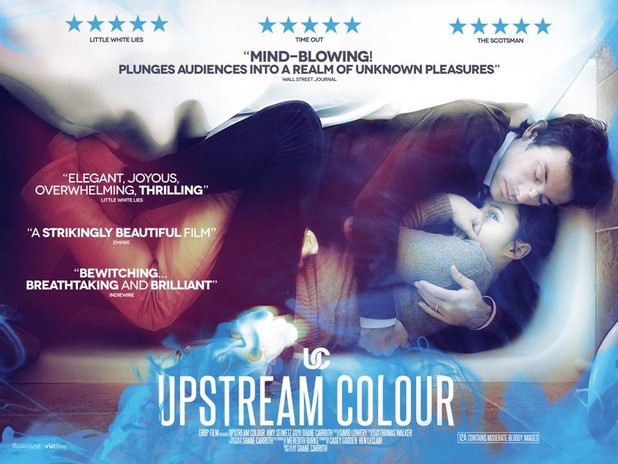
(Film Review) Upstream colour (2012): a dream-like experience.

Rating: 7.2/10.0

If you like Terrence Malick’s visuals, or if you liked Primer, you will most likely enjoy this movie. However, if you are a more action type and struggles with slow-paced movies, you may want to sit this one out.

This movie’s visuals and soundtrack are amazing and create an experience of its own. I am willing to let a lot go for decent visuals. In the case of Upstream Colour, the visuals and sound compensate for a not-so-linear plot and dialogue. The tranquil shades of blue and open shots of the second half of the movie; compensate for a much darker and intense first half.

The plot, in a nutshell, without trying to spoil anything is about two people that had their lives turned inside out after being exposed to a mind-controlling substance. They don’t know how that has happened, all they lived with is the consequences of days “under the influence” when they have transfer all their possessions to an unidentified man. Kris and Jeff meet and are obviously drawn to each other, but they don’t know why and their lives have more link then they would initially think.

The acting is not superb across the board, but the main actors are good. Actress Amy Seimetz does a nice job in conveying the confusion and distress of someone who doesn’t know what is happening to them or why. Main actor and director Shane Carruth does a decent job as reserved Jeff, whose attraction for Kris joins a long list of unexplained events in his life.

It is easy to approach this literally, however this perspective ends up following short, especially in the end. There are several plot lines that don’t get closure or a satisfying explanation. So, I would face the story as memories and dream flashes, it makes the flowing of the narrative more comprehensible. Overall, this movie is a thoroughly pleasant sensorial experience.

First posted at Post-Production Reviews. Link to the film’s IMDB page.

(Film Review) Red 2 (2013): When you wished they had just retired already.

Rating: 3.0/10.0

To be fair, going to see Red 2 was not my first choice and I didn’t went to the cinema expecting much. I actually enjoyed the first movie, it was different and it had this great sense of fun, however this is a completely different beast. Red 2 has managed to kill all joy and novelty of the first by turning all characters in caricatures and going for the over-the-top antics.

In terms of visuals, this movie looks good. The effects are well done and the scenery shots around the World are quite beautiful and well made. However, the plot is so flawed, that decent visuals alone cannot make it work. The only really good fight scenes are Helen Mirren’s or Byung-hun Lee, which has significant screen time, but couldn’t be less flashed out. Plus, the way his dispute with Bruce Willis gets resolved is so unbelievable it is laughable.

The movie is begins on Frank (Bruce Willis) and Louise (Mary-Louise Parker) relationship. Now, that in itself has plenty of potential. How does a relationship that began in an adrenaline high manages to function on a safe everyday basis? Right? No, that’s not really where this movie goes. We get a tired and bored looking Willis who doesn’t really commit to the role, while the previous affable and relatable Louise gets an “air-head-adrenaline-junkie-token-girl” treatment. Her character makes cringe so many times that one have to question if somebody that devoid of common sense would survive on those situations. Catherine Zeta-Jones plays a Russian seductress whose relationship with Willis is as believable as her accent.

John Malkovich can play alternative, cookie and paranoid agent like no other. There is something in Malkovich’s demeanour that makes that mix of genius and danger all that believable. Helen Mirren and Anthony Hopkins are the best things in this movie, though. Helen Mirren just gets the tone right and compensates with impeccable acting what could have been a pretty bland character.

This movie didn’t manage to fulfil my low expectations, but it was so gimmicky and shallow (especially the three spinning car scenes) that it was just ruined for me.

First posted at Post-Production Reviews. Link to the film’s IMDB page.

(Film review) Frances Ha (2013): Fun, light-hearted experience of being a struggling young artist in New York

Rating: 9.5/10.0

There is much to be said about coming of age movies or of a particular style of New York based fast-talked movies. Since its release, Frances Ha has been much compared to Manhattan – for the black and white stylistic choices; it’s clear infatuation for New York and a central character in its quest for coherence (no, I don’t mean Link). However, these movies similarities end there. Frances is a corky dancer whose dream is to be a part of the main “group”. She is smart, well read and sweet, but she is also broke, surrounded by wealthy pseudo-artist-intellectual friends and her social awkwardness is borderline painful sometimes.

Unlike, Woody Allen’s character in Manhattan, Frances is endearing dreamer and somewhat relatable. In a world post-financial crisis, it’s not difficult to be or find friends who are struggling to make it at their chosen profession, especially artists in their mid to late 20s. Alongside Frances, we embark on this journey on trying to make her passion for dance a reality, even if not in very traditional ways. Moreover, this is a movie about friendship. Frances and her best friend’s path begin to diverge and their almost symbiotic relationship becomes to crumble when her friend becomes more seriously involved in a romantic relationship. It’s very accurate in its depiction of how those types of close relationships adapt or deteriorate when another party is involved. However unlike a lot of movies that have female friendships, there is no stereotypical competition or cattiness amongst these two. Much like their dreams of being successful artists, they had planned a life in New York together and that changed as well.

The soundtrack is brilliant and the acting is great, definitely would recommend watching.

First posted at Post-Production Reviews on 2012. Link to the movie’s IMDB page.

Guia de Sobrevivência Vegetariano em Lima

Ser uma brasileira vegetariana parece ser algo peculiar. Ser uma brasileira vegetariana viajando pela América do Sul definitivamente tem seus desafios. Mas, em Lima, eu descobri várias opções (até mais do que no Rio) para ser vegetariana e feliz, sem nenhum problema.

Esse é um artigo mais de dicas de onde ir, o que experimentar… E o que não vale tanto a pena. Vale a pena ressaltar que alguns desses lugares valem muito a pena tanto para vegetarianos quanto para não vegetarianos.

Dica: se você é vegetariano/a ou vegan e não conhece Happy Cow, está perdendo um excelente recurso para encontrar restaurantes vegetarianos novos. Uma vez eu descobri um restaurante na rua da minha casa no Rio que eu nunca teria imaginado, simplesmente porque eu achei que era só um templo Hare Krishina.

Opção de prato principal: Versão Veggie do tradicional “Lomo Saltado”

Às vezes eu acho que sou uma vegetariana de mentira, porque eu ADORO essas versões vegetarianas de pratos tradicionais. O “Lomo” saltado tradicional é feito com carne - aqui tofu ou carne de glúten, cebola, pimentões, tomate mais uma porção de batata frita e arroz, nesse caso integral.

Apesar da foto ser do Bircher-Benner, eu achei o Lomo Saltado veggie do “El Paraiso Bio Leben” bem melhor. Fora que a refeição completa entrada (uma salada gigantesca), prato principal (Lomo), bebida (limonada) e sobremesa (arroz com leche) custou 15 soles.

IMG_0363

O Arroz chaufa de vegetais é outra opção super tradicional, que pode ser encontrado em qualquer Chifa (restaurante chinês-peruano). Sempre existe a opção de vegetais, então esse não vai ser o problema… O problema é terminar a montanha de arroz que vão colocar na sua frente.

Arroz_chaufa_simple

Opção para beliscar: Yucas rellenas con queso

Yucas-Rellenas-con-Queso

É uma mistura de bolinha de queijo com bolinho de aipim maravilhosa que você encontra em qualquer bar, botequim ou supermercado. Tequeños são como mini-pastéis de queijo… Então, não faz muita diferença a não ser que você esteja com saudade de casa.

Opção alcóolica: Maracuyá Sour

Maracuya sourPisco em si é uma delícia, mas tem algo especial no Maracuyá Sour. A Bomboniere, restaurante que você encontra no Larcomar tem talvez os melhores Maracuyás sours, mas você pode encontrar essa versão deliciosa em praticamente qualquer restaurante. Só cuidado, vegans, o drink leva gema de ovo.

Uma menção honrosa deve ser feita ao restaurante Almazen, que não só tem uma comida vegetariana excepcional, tem provavelmente uma das melhores cozinhas vegetarianas que eu já comi na vida, além do restaurante ser um charme. Só prepare para pagar um pouco.

IMG_0368

Assim que, para mim, me adaptar a vida vegetariana em Lima foi bastante fácil. São vários restaurantes ótimos e todos com muitas opções pra mim. Mais ainda, os garçons e garçonetes dos restaurantes estão bem preparados para te ajudar e “adaptar” um prato se necessário. Minha única preocupação é a balança, de resto, eu estou bastante satisfeita.

Postado originalmente em Brasileiras pelo Mundo.

The State of HR in International Humanitarian and Development Organisations 2013

This report urges people to plan now for the future. The paper looks at human resources challenges in the humanitarian and development sector over the last 12 months.

The report focuses on the changing landscape in recessionary times and how this climate of uncertainty presents challenges to the sector.

“HR’s list of problems to solve, issues to improve on and priorities to set is just getting longer. Whether strategic or transactional, they are all in their way critical to the overall operational excellence of any INGO. By recognising, questioning and engaging with the challenges, however, we can make a conscious effort to improve HR, it is possible to foster positive change.”

Introducing the State of HR 2013, People In Aid Executive Director Jonathan Potter explained the need for the report: “If you work in the humanitarian and development sector, you need to read this paper. We have made it short and easy to read so that everyone can benefit from the insights into the current trends in HR and people management. The report encourages you to think about what might be needed to transform and prepare your organisation for what lies around the corner.”

Find the complete report here.

The campaign "16 days of action against Gender-Based violence" is arriving and you can be part of it!

Letter of CWGL for all of those who want to be part of the campaign:

Dear Activist,

In these turbulent times, the global theme of the 16 Days Campaign, “From Peace in the Home to Peace in the World”, could not be more pertinent. During the last year we have witnessed gender-based violence targeted at women in the streets, at home, and in the workplace as they go about their daily activities and defend their rights; and so the struggle continues. The Center for Women’s Global Leadership (CWGL) is excited to share with you the 2014 Take Action Kit for the 16 Days of Activism Against Gender-Based Violence Campaign.

It remains critically important to address the intersections of gender-based violence and militarism in the lives of women, men, and whole communities. As a set of ideas and values, militarism is pervasive and has detrimental effects on the safety, security and dignity of all peoples. Militarism is rooted in patriarchal beliefs about gender, and influences how we are socialized to believe in and act upon stereotypes. Militarism enables perpetrators of violence to act with impunity, governments to sanction discriminatory and unequal legislation and policies, and societies to condone and promote harmful cultural practices.

There is no better time than during the 16 Days Campaign to advocate for an end to gender-based violence, in all its forms – from child marriage to femicide, from attacks on Women Human Rights Defenders to violations of women’s right to land and access to productive resources.

Join activists who believe that women’s human rights are indivisible by participating in this year’s 16 Days Campaign! The Campaign is highlighting three priority areas that affect issues of gender-based violence in cross-cutting ways: 1) Violence Perpetrated by State Actors; 2) Proliferation of Small Arms in Cases of Intimate Partner Violence; and 3) Sexual Violence During and After Conflict. These priority areas encompass a multitude of vital issues. By participating in the 16 Days Campaign, you can choose to take action most relevant to your context.

Regardless of the issues you choose to focus on this year, we encourage you to adapt the Take Action Kit materials so that they are relevant for local work. We encourage you to find ways to connect with the international theme and work in solidarity with other activists around the world. We hope you will find the enclosed Campaign materials helpful as you plan your events for this year’s 16 Days Campaign.

In the Take Action Kit, you will find the following materials:

Theme Announcement

Information on Violence Perpetrated by State Actors; Proliferation of Small Arms in Cases of Intimate Partner Violence; Sexual Violence During and After Conflict; on Gender-Based Violence, Women Human Rights Defenders, and State Accountability; on What is Militarism?; and on Gender-Based Violence in the Workplace.

Profiles on the Post 2015 Women’s Coalition, the Beijing+20 process, and information on writing grant proposals, creating a press release, and using social media, along with 16 Days Campaign and Center for Women’s Global Leadership brochures which you can share.

Links to all of the materials in the Kit are available online at: http://16dayscwgl.rutgers.edu/2014-campaign/2014-take-action-kit. Share your planned actions on the International Campaign Calendar: http://16dayscwgl.rutgers.edu/campaign-calendar. Submit photos and see them on the 16 Days Flickr page (http://www.flickr.com/photos/16dayscampaign/), or share your videos, advocacy materials, newspaper articles, and reports with us.

Thank you for being part of the 16 Days Campaign in the effort to end gender-based violence!

In solidarity,

Savi Bisnath, PhD

Borgen Magazine: Q&A with Natasha Leite

flatcover1

SEATTLE — Natasha Leite has nine years of experience working as a governance expert in Latin America, the Caribbean, Africa and Asia. She has recently written a book on development work called “Doing What You Love! A Straightforward Guide to a Career in International Development” that can be found here. You can also subscribe to her newsletter on development, follow her other articles or learn about a career in development or job opportunities on her Facebook page.

Here is my Q&A with Natasha Leite:

1. What does the “new generation of development professionals” look like?

This new generation of development professionals have probably grew up with the idea of development workers from the 90s and 00s… In a very romanticized way. Alongside the Generation Y high expectations for their (our) future came the idea that your work should also be meaningful and, for many, that translates into development work. They are also more educated and tech-savvy than the generation before… Because, well, we grew up with this technology and a market that demanded more qualification.

2. Why is there a divide between the two generations? What changes exist and why?

The main divide between the two generations is that previous development workers didn’t graduate in international development or have related MAs. They value much more practice-based education and work experience, which has led to a lot of activities that were implemented on a trial and error basis. In turn, this generation has focused on getting advanced degrees early. And even though we graduate much earlier, it’s easier for all this knowledge to become wasted if there is no relation with practice. Furthermore, having a bit of practical experience (if that is your goal) before going to graduate school can significantly alter your perspectives on work, on what do you want to focus in your degree and how to make the most out of that experience.

Also, there is a different profile… Before, most aid workers came from semi-diplomatic backgrounds (for headquarters) or field workers who were sort of a mix of misfits/adventurous/missionaries who were expecting to face a lot of hardships, but they would do it anyway. Not many protocols or standards of protection. Today, we have an array of intermediate positions and much more job security and professionalization of the area (which is a positive, in my opinion). People today are more entitled than before, when they knew that this would be a difficult process. Plus, today, there is a lot more ownership of local knowledge and local experts, so it is truly a global competition (which I also add to the good aspects).

3. What are various challenges that this generation faces? How and why are they different from those that previous generations faced?

This generation faces more competition for sure. Most professionals can find a related area of expertise in the nonprofit world. You can be a doctor for MSF or an engineer for UNICEF. However, social scientists and humanities students have to work double to establish themselves as viable and valuable candidates.

Also, there is a lot more being requested from entry-level workers than before. It’s not good enough to know English. You have to know English and another U.N. language, plus a local language if that language is not among big 6 (Arabic, English, French, Mandarin, Spanish and Russian). Plus, if you want to work abroad you must have some outside-country experience and related-experience, which usually is a tall order from someone who has just graduated at 21-22. So, I would start thinking local before going global.

The other good aspect from previous generations in that they had no rush to get where they got. They knew where they wanted to be, so they didn’t mind investing the time to get [there]. We grew up on a diet of instant gratification, so patience is something that many have to work on.

4. Why do you believe that investors should focus on this generation and the work they do?

I think investors should focus on great ideas, innovative solutions, ownership and prioritizing the views of local communities, supporting projects for longer periods of time (5 years, instead of the current year-funding madness)… Regardless of the generation it is coming from.

5. Why do you think it is important to change things on a global scale?

I think it is important to change things in a local scale globally, especially social injustice. If everybody had a chance of dignified living, our collective existence would improve greatly. We don’t live by ourselves. We share this world with a lot of people, most of whom don’t share our privileges and don’t have the access to the same opportunities.

I think it is part of our job – as development workers, but also as a society – to be more tolerant and supportive with one another. Yes, we have to support the development of individuals, but we also have to empower communities and encourage social cohesion in order to create peaceful coexistence and inclusive societies.

6. If you could invest a billion dollars in improving the world, how would you spend it?

Uff… That’s a difficult question. Twenty percent I would spend it in 5-year innovative peace projects that could chance their priorities according to evaluations and communities’ priorities.

Another 20 percent I would spend in girls’ education where the educational gap between boys and girls is more critical. Women are half of the world’s population, but in most countries their ability to transform and improve their communities is limited due to patriarchal values that lead us nowhere.

Definitely would invest in the other 20 percent in sexual and reproductive health rights. It’s been 20 years since the International Conference for Population Development and we have progressed. In many cases, it even seems like we are moving backwards. We desperately need family planning, sexual education, but also appropriate clinics and support for people who have been sexually assaulted in conflict and emergency scenarios.

Twenty percent I would spend on legal and psychosocial support for victims of human trafficking; it’s the fastest growing criminal trend and the actions being taken to curb come once again from a perspective of criminalizing the victims.

Last, but not least, I would invest my last 20 percent in restorative justice. Supporting our justice systems to become much more focused on what the victim needs to move on with her life than to focus on punishing the guilty and creating one more instrument of “social control” of the most underprivileged.

I chose those areas because I believe they have major repercussions on people’s lives. But also, because I believe they are the ones that create the least dependency. I also think that the existing investment on those areas is: a) very limited or b) very restrictive.

7. Further comments:

I think we have enhanced the quality of development work a lot. We pay more attention to the sustainability of our actions and their future consequences. The field is a lot more democratic and communities have a bigger role in the development of projects. It does make the process a little more burocractic, but there is also a lot more transparency and accountability.

This article was originally posted at Borgen Magazine.